<?xml version="1.0" encoding="iso-8859-1"?>
<!DOCTYPE html PUBLIC "-//W3C//DTD XHTML 1.1 Transitional//EN" "xhtml1-transitional.dtd">
<?xml-stylesheet type="text/xsl" href="pmathml.xsl"?>
<html xmlns="http://www.w3.org/1999/xhtml">
  <head>
    <meta name="generator" content="HTML Tidy for Windows (vers 15 August 2007), see www.w3.org" />
    <title>
      Introduction to climate dynamics and climate modelling - Energy balance models
    </title>
    <meta http-equiv="Content-Language" content="fr" />
    <meta http-equiv="Content-Type" content="text/html; charset=UTF-8" />
    <link type="text/css" rel="stylesheet" media="screen" href="style.css" />
    <style type="text/css">
/*<![CDATA[*/
    span.c2 {font-style: italic}
    div.c1 {text-align: center}
    /*]]>*/
    </style>
    <link media="print" href="print.css" type="text/css" rel="stylesheet" />
    <script type="text/javascript" src="menu.js">
</script>
    <script type="text/javascript" src="search_in_the_page.js">
</script>
    <style type="text/css">
/*<![CDATA[*/
    div.c1 {text-align: center}
    /*]]>*/
    </style>
  </head>
  <body>
    <div id="site">
      <div id="header"></div>
      <div id="sous-header">
        <div id="mh">
          <dl>        		
            <dt>
              <a href="index.html" title="Home">Home</a>
            </dt>        	
          </dl>	         	
          <dl>			         		
            <dt id="menu1" onmouseover="MontrerMenu('ssmenu1');" onmouseout="CacherDelai();">
              <a href="contents.html" title="Contents" onmouseover="MontrerMenu('ssmenu1');" onfocus="MontrerMenu('ssmenu1');">Contents</a>
            </dt>        			
            <dd id="ssmenu1" onmouseover="AnnulerCacher();" onmouseout="CacherDelai();" onfocus="AnnulerCacher();" onblur="CacherDelai();">        				
              <ul>        					<li>
                <a href="preface.html">Preface</a></li>        					<li>
                <a href="chapter1_node1.html"><NOBR>1. Climate system</NOBR></a></li>        					<li>
                <a href="chapter2_node1.html"><NOBR>2. Energy balance</NOBR></a></li><li>
                <a href="chapter3_node1.html"><NOBR>3. Modelling</NOBR></a></li>        					<li>
                <a href="chapter4_node1.html"><NOBR>4. Perturbations</NOBR></a></li>                  <li>
                <a href="chapter5_node1.html"><NOBR>5. Brief history</NOBR></a></li>  
                <li><a href="chapter6_node1.html"><NOBR>6. Future climate changes</NOBR></a></li>       				
              </ul>        			
            </dd>        	
          </dl>        	  
          <dl>            
            <dt> 
              <a href="symbols.xml" title="Symbols and acronyms">Symbols and acronyms</a>
            </dt>        	
          </dl>	           
          <dl>            
            <dt> 
              <a href="glossary.xml" title="Glossary">Glossary</a>
            </dt>        	
          </dl>	         	
          <dl>            
            <dt>
              <a title="eBook"  href="ebook.html">eBook</a>
            </dt>          
          </dl>	         	
          <dl>            
            <dt>
              <a title="Search" href="http://www.elic.ucl.ac.be/cgi-bin/search/search.pl">Search</a>
            </dt>          
          </dl>	         	
          <dl>            
            <dt>
              <a title="History" href="history.html">History</a>
            </dt>          
          </dl>	         	
                 	
          <dl>            
            <dt>
              <a title="About" href="about.html">About</a>
            </dt>          
          </dl>	         	
          <dl>        	
          </dl>
        </div>
      </div>
      <div id="corp">
        <div id="left">
          <div id="contenu-left">
            <div id="title">
              Description
            </div>
            <div id="contenu-menu">
                <a href="index.html">Introduction to climate dynamics and climate modelling</a>
                <br />
                <!--[if IE]>
                <div align="right"><br />
                  <a style="color: #D86C03" href="javascript:self.print()">Print this page</a>
                </div>
                <![endif]-->             
                <!--[if !IE]><!-->
                <div style="margin-bottom: -15px; margin-top: 5px;" align="right">
                  <a style="color: #D86C03" href="javascript:self.print()">Print this page</a>
                </div>
                <!--<![endif]-->
            </div>
            <div id="title">
              Contact
            </div>
            <div id="menu">
              <a href="http://www.elic.ucl.ac.be/index.php?page=hgs%23HomePage">Hugues
              Goosse</a><br />
              <br />
              <a href="mailto:pierre-yves.barriat@uclouvain.be">Webmastering</a><br />
              <br />
              <a href="http://www.elic.ucl.ac.be/">Institut</a>            
            </div>
            <br />             
            <div id="title">References</div>
            <div id="menu">
                <a href="chapter3_node24.html">Cited references</a><br /><br />
                <a href="chapter3_node26.html">Web links</a><br /><br />
                <br />               
            </div>
            <!--[if IE]>
                          <div id="title">Technical Note</div>
                          <div id="contenu-menu" align="center">
                            <img alt="Caution" style="border-width:0" src="./images/caution.gif" /><br />
                            Your browser need to support MathML.<br />
                Microsoft Internet Explorer 6 or above, require the
                            <a style="color: #D86C03" href="http://www.mathplayer.com/en/products/mathplayer/welcome.asp">
                            MathPlayer  plugin</a>.
                          <br />
                          </div>  
                        <![endif]-->             
            <!--[if !IE]><!-->               
            <div id="title">Technical Note
            </div>              
            <div id="contenu-menu" align="center">                
              <img alt="Caution" style="border-width:0" src="./images/caution.gif" /><br />
              Your browser need to support MathML.<br />
                Firefox require an additional                 
                <a style="color: #D86C03" href="fonts.html">mathematics fonts package</a>.             <br />              
            </div>            
            <!--<![endif]-->
                    
            <div id="title">Copyright
            </div>              
            <div id="contenu-menu" align="center"> 
              <br />               
              <a rel="license" href="http://creativecommons.org/licenses/by-nc/3.0/" target="_blank">
              <img alt="Creative Commons License" style="border-width:0" src="http://i.creativecommons.org/l/by-nc/3.0/88x31.png" /></a>
              <br />
              Content on this site is licensed under a 
              <a style="color: #D86C03" target="_blank" rel="license" href="http://creativecommons.org/licenses/by-nc/3.0/">Creative Commons License</a>.              
<!-- phpmyvisites -->
<br /><br /><a href="http://www.elic.ucl.ac.be/textbook/phpmv2/" title="phpMyVisites | Open source web analytics"
onclick="window.open(this.href);return(false);"><script type="text/javascript">
<!--
var a_vars = Array();
var pagename='';

var phpmyvisitesSite = 1;
var phpmyvisitesURL = "http://www.elic.ucl.ac.be/textbook/phpmv2/phpmyvisites.php";
//-->
</script>
<script language="javascript" src="http://www.elic.ucl.ac.be/textbook/phpmv2/phpmyvisites.js" type="text/javascript"></script>
<object><noscript><p>phpMyVisites | Open source web analytics
<img src="http://www.elic.ucl.ac.be/textbook/phpmv2/phpmyvisites.php" alt="Statistics" style="border:0" />
</p></noscript></object></a>
<!-- /phpmyvisites -->               
            </div>
        </div>
    </div>
    <div id="right">
          <div id="contenu-right">
            
            <div class="navigation">
              <!--Navigation Panel-->
              <a name="tex2html1459" href="chapter3_node7.html" id="tex2html1459"><img align=
              "bottom" border="0" alt="Next" src="./images/next.gif" /></a>&#160;<a name="tex2html1453"
              href="chapter3_node5.html" id="tex2html1453"><img align="bottom" border="0" alt="Up"
              src="./images/up.gif" /></a>&#160;<a name="tex2html1447" href="chapter3_node5.html" id=
              "tex2html1447"><img align="bottom" border="0" alt="Previous" src=
              "./images/prev.gif" /></a><br />
              <b>Next:</b>&#160;<a name="tex2html1460" href="chapter3_node7.html" id=
              "tex2html1460">3.2.2 Intermediate complexity models</a> <b>Up:</b>&#160;<a name=
              "tex2html1454" href="chapter3_node5.html" id="tex2html1454">3.2 A hierarchy of
              models</a> <b>Previous:</b>&#160;<a name="tex2html1448" href="chapter3_node5.html" id=
              "tex2html1448">3.2 A hierarchy of models</a><br />
              <br />
            </div><!--End of Navigation Panel-->
            <h2>
              <a name="SECTION00621000000000000000" id="SECTION00621000000000000000"></a> <a name=
              "section321" id="section321"></a> <span class="arabic">3</span>.<span class=
              "arabic">2</span>.<span class="arabic">1</span> Energy balance models
            </h2>
            <p>
              As indicated by their name, energy balance models estimate the changes 
              in the climate system from an analysis of the energy budget of the Earth. 
              In their simplest form, they do not include any explicit spatial dimension, 
              providing only globally averaged values for the computed variables. They are 
              thus referred to as zero-dimensional EBMs. The basis for these EBMs was introduced 
              by both Budyko (1969) and Sellers in (1969). Their fundamental equation is very 
              similar to those analysed in 
              sections <a href="chapter2_node3.xml">2.1.1</a> and <a href=
              "chapter2_node7.xml">2.1.5</a>:
            </p>
            <p>
              <center>Changes in heat storage = absorbed solar radiation - emitted terrestrial radiation</center>
            </p>
            <div class="mathdisplay c1">
              <a name="GrindEQ__3_1_" id="GrindEQ__3_1_"></a><!-- MATH
 \begin{equation}
C_{E} \frac{\partial T_{s} }{\partial t} =\left(\left(1-\alpha _{p} \right)\frac{S_{0} }{4} -A\uparrow \right)
\end{equation}
 -->
              <table class="equation" cellpadding="0" width="90%" align="center">
                <tr valign="middle">
                  <td nowrap="nowrap" align="center">
<math xmlns="http://www.w3.org/1998/Math/MathML" display="block" 
overflow="scroll"><msub><mi>C</mi><mi>E</mi></msub><mfrac><mrow><mo>&#x2202;
</mo><msub><mi>T</mi><mi>s</mi></msub></mrow><mrow><mo>&#x2202;</mo><mi>t</mi>
</mrow></mfrac><mo>=</mo><mfenced close=")" open="(" separators=""><mfenced 
close=")" open="(" separators=""><mn>1</mn><mo>-</mo><msub><mi>&#x03B1;</mi>
<mi>p</mi></msub></mfenced><mfrac><msub><mi>S</mi><mn>0</mn></msub><mn>4</mn>
</mfrac><mo>-</mo><mi>A</mi><mo>&#x2191;</mo></mfenced></math>

                  </td>
                  <td nowrap="nowrap" class="eqno" width="10" align="right">
                    (<span class="arabic">3</span>.<span class="arabic">1</span>)
                  </td>
                </tr>
              </table>
            </div><br clear="all" />
            <p>
              where, as in section <a href="chapter2_node7_2.xml">2.1.5.2</a>, <i>C<sub>E</sub></i> is the
              effective heat capacity of the media (measured in J m<sup>-2</sup> K<sup>-1</sup>), <i>T<sub>s</sub></i> the surface temperature, 
           <i>t</i> the time, 
 <math xmlns="http://www.w3.org/1998/Math/MathML" overflow="scroll"><msub><mi>&#x03B1;</mi><mi>p</mi></msub></math> the planetary
              <a href="glossary_a.html#albedo">albedo</a>, <i>S<sub>0</sub></i> the <a href="glossary_t.html#total_solar_irradiance">Total Solar Irradiance</a>
              (TSI) and <i>A</i><math xmlns="http://www.w3.org/1998/Math/MathML" overflow="scroll"><mo>&#x2191;</mo></math>
            
              the total amount of energy
              that is emitted by a 1 m<sup>2</sup> surface of the
              Earth. <i>A</i><math xmlns="http://www.w3.org/1998/Math/MathML" overflow="scroll"><mo>&#x2191;</mo></math> could be represented on the basis of
              the <a href="glossary_s.xml#stefan_boltzmann_law">Stefan-Boltzmann law</a>, using a factor 
 <math xmlns="http://www.w3.org/1998/Math/MathML" overflow="scroll"><msub><mi>&#x03C4;</mi><mi>a</mi></msub></math>
 to represent the infrared transmissivity of the atmosphere (including the
              greenhouse gas effect), as
            </p>
            <div class="mathdisplay c1">
              <a name="GrindEQ__3_2_" id="GrindEQ__3_2_"></a>
              <table class="equation" cellpadding="0" width="90%" align="center">
                <tr valign="middle">
                  <td nowrap="nowrap" align="center">
                  
  <math xmlns="http://www.w3.org/1998/Math/MathML" display="block" overflow="scroll">
    <mi>A</mi>
    <mo>&#x2191;</mo>
    <mo>=</mo>

    <mi>&#x03B5;</mi>
    <mi>&#x03C3;</mi>
    <msubsup>
      <mi>T</mi>
      <mi>s</mi>
      <mn>4</mn>
    </msubsup>

    <msub>
      <mi>&#x03C4;</mi>
      <mi>a</mi>
    </msub>
  </math>

                  </td>
                  <td nowrap="nowrap" class="eqno" width="10" align="right">
                    (<span class="arabic">3</span>.<span class="arabic">2</span>)
                  </td>
                </tr>
              </table>
            </div><br clear="all" />
            <p>
              where <math xmlns="http://www.w3.org/1998/Math/MathML" overflow="scroll"><mi>&#x03B5;</mi></math> is the emissivity of the surface. Using an
              albedo of 0.3, and an emissivity of 0.97, a value of 
 <math xmlns="http://www.w3.org/1998/Math/MathML" overflow="scroll"><msub><mi>&#x03C4;</mi><mi>a</mi></msub></math>
              of 0.64 leads to an equilibrium temperature <i>T<sub>s</sub></i> = 287K, which is close to the observed one.
              In some EBMs, Eq. (<a href="#GrindEQ__3_2_">3.2</a>) is linearised to give an even
              simpler formulation of the model. On the other hand, 
 <math xmlns="http://www.w3.org/1998/Math/MathML" overflow="scroll"><msub><mi>&#x03C4;</mi><mi>a</mi></msub></math> and 
 <math xmlns="http://www.w3.org/1998/Math/MathML" overflow="scroll"><msub><mi>&#x03B1;</mi><mi>p</mi></msub></math>

 are often
              parameterised as a function of the temperature, in particular to take into account
              the fact that cooling increases the surface area covered by ice and snow, 
              and thus increases the planetary albedo.
            </p>
            <p>
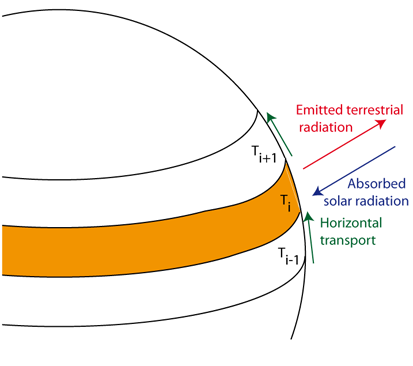
              In order to take the geographical distribution of temperature at the Earth’s 
              surface into account, zero-dimensional EBMs can be extended to include one 
              (generally the latitude) or two horizontal dimensions  (Fig. <a href="#image3x03">3.3</a>). 
              An additional term <math xmlns="http://www.w3.org/1998/Math/MathML" overflow="scroll"><mi>&#x0394;</mi><mi>transp</mi></math> is then  included in
              Eq. <a href="#GrindEQ__3_1_">3.1</a> representing the net effect of heat input and output
              associated with horizontal transport:
            </p>
            <div class="mathdisplay c1">
              <a name="GrindEQ__3_3_" id="GrindEQ__3_3_"></a>
              <table class="equation" cellpadding="0" width="90%" align="center">
                <tr valign="middle">
                  <td nowrap="nowrap" align="center">
<math xmlns="http://www.w3.org/1998/Math/MathML" display="block" 
overflow="scroll"><msub><mi>C</mi><mi>E</mi></msub><mfrac><mrow><mo>&#x2202;
</mo><msub><mi>T</mi><mrow><mi>s</mi><mi>,</mi><mi>i</mi></mrow></msub></mrow>
<mrow><mo>&#x2202;</mo><mi>t</mi></mrow></mfrac><mo>=</mo><mfenced close=")" 
open="(" separators=""><mfenced close=")" open="(" separators=""><mn>1</mn><mo>
-</mo><msub><mi>&#x03B1;</mi><mi>p</mi></msub></mfenced><mfrac><msub><mi>S</mi>
<mn>0</mn></msub><mn>4</mn></mfrac><mo>-</mo><mi>A</mi><mo>&#x2191;</mo>
</mfenced><mo>+</mo><mi>&#x0394;</mi><mi>transp</mi></math>


                  </td>
                  <td nowrap="nowrap" class="eqno" width="10" align="right">
                    (<span class="arabic">3</span>.<span class="arabic">3</span>)
                  </td>
                </tr>
              </table>
            </div><br clear="all" />
            <p>
              An index <i>i</i> has been added to the surface temperature to
              indicate that the variable corresponds to the region <i>i</i>.
              The simplest form for the transport is to treat it as a linear 
              function of temperature, but more sophisticated parameterisations 
              are also used, including, for instance, a diffusion term.
            </p>
            <div align="center">
              <a name="image3x03" id="image3x03"></a><a name="3086"></a>
              <table>
                <caption align="bottom"><p align="center">
                  <strong>Figure 3.3:</strong> Representation of a one-dimensional EBM for which the
                  temperature <i>T<sub>i</sub></i> is averaged over a band of longitude.
                </p></caption>
                <tr>
                  <td>
                    <div class="c1">
                      <img  align="bottom" border="0" src="./images/image3x03.png"
                      alt="Image image3x03" />
                    </div>
                  </td>
                </tr>
              </table>
            </div>
            <p>
              Box models have clear similarities to EBMs as they represent large areas or an entire 
              component of the system by an average which describes the mean over one “box”. 
              The exchanges between the compartments are then <a href="glossary_p.html#parameterization">parameterised</a> as a function
              of the characteristics of the different boxes. The exact definition of the boxes depends on the purpose of the model. 
              For instance, some box models have a compartment for the atmosphere, the land surface, the ocean surface layers 
              and the deep ocean, possibly making a distinction between the two hemispheres. Others include additional components 
              allowing a description of the carbon cycle and thus have boxes corresponding to the various reservoirs described in 
              section <a href="chapter2_node10.html">2.3</a>.
            </p>
            <hr />
            <div class="navigation">
              <!--Navigation Panel-->
              <a name="tex2html1459" href="chapter3_node7.html" id="tex2html1459"><img align=
              "bottom" border="0" alt="Next" src="./images/next.gif" /></a>&#160;<a name="tex2html1453"
              href="chapter3_node5.html" id="tex2html1453"><img align="bottom" border="0" alt="Up"
              src="./images/up.gif" /></a>&#160;<a name="tex2html1447" href="chapter3_node5.html" id=
              "tex2html1447"><img align="bottom" border="0" alt="Previous" src=
              "./images/prev.gif" /></a><br />
              <b>Next:</b>&#160;<a name="tex2html1460" href="chapter3_node7.html" id=
              "tex2html1460">3.2.2 Intermediate complexity models</a> <b>Up:</b>&#160;<a name=
              "tex2html1454" href="chapter3_node5.html" id="tex2html1454">3.2 A hierarchy of
              models</a> <b>Previous:</b>&#160;<a name="tex2html1448" href="chapter3_node5.html" id=
              "tex2html1448">3.2 A hierarchy of models</a>
            </div>
          </div>
        </div>
      </div>
    </div>
        <div id="footer">
          <p>
            <a rel="license" href="http://creativecommons.org/licenses/by-nc/3.0/" target="_blank">© The authors 2008</a> - <a href="http://www.uclouvain.be/">Université catholique de Louvain</a> - <a href=
            "http://www.graphiques-kits.com" title=
            "Des kits graphiques professionnels gratuits !">Design par Graphiques-Kits</a> - <a href="mailto:hugues.goosse@uclouvain.be">Email for Corrections and Suggestions</a>
          </p>
        </div>
  </body>
</html>